

CLIENT EDUCATION SERIES | ARTICLE 2 OF 4
The decision made under pressure mattered more than the forecast
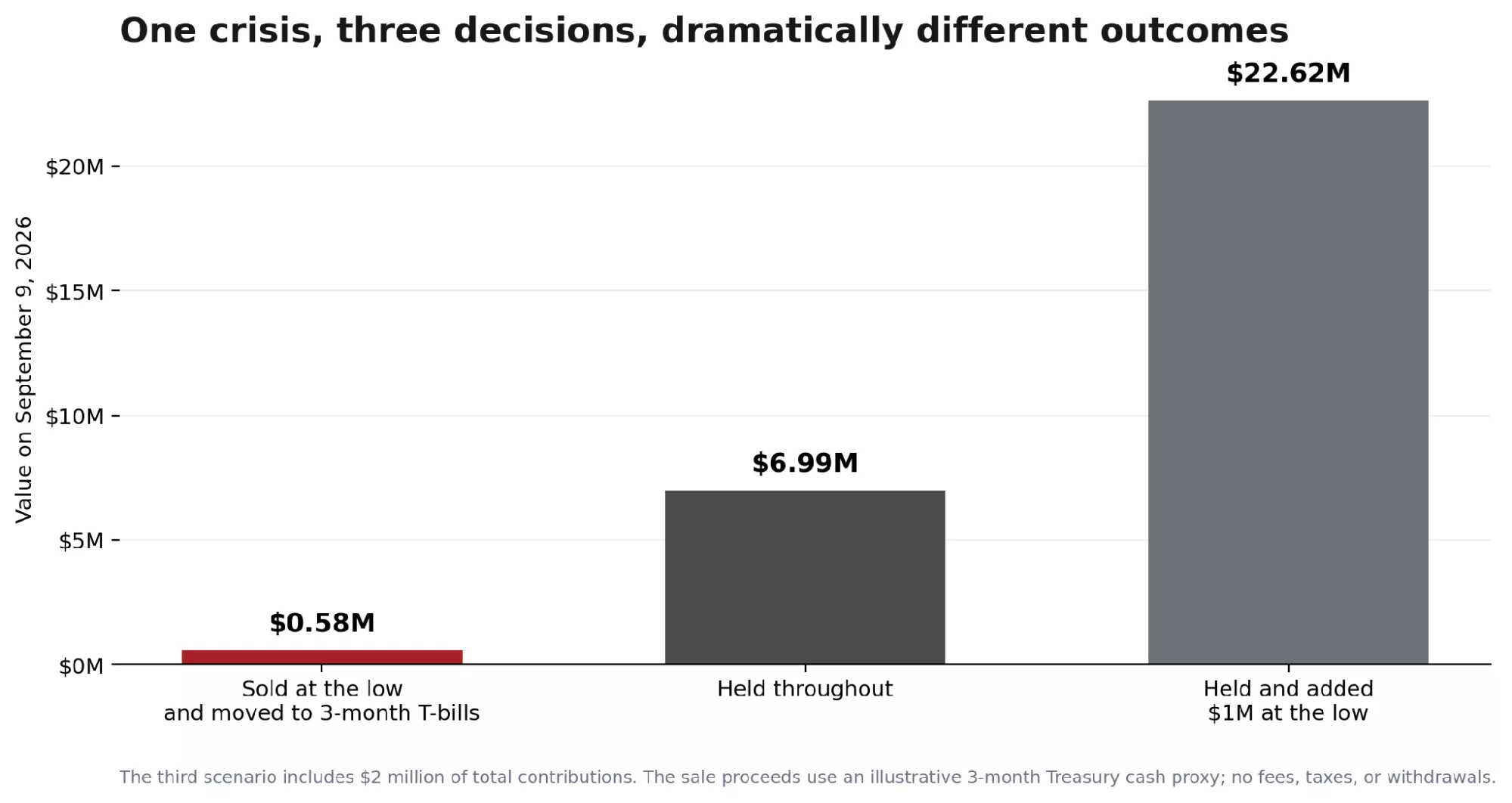
Imagine three investors who each placed $1 million into the S&P 500 at the October 2007 peak. By March 9, 2009, each had experienced the same decline. From that day forward, their choices diverged.
| Investor | Decision at low | Total contributed | Value 9/9/26 |
|---|---|---|---|
| Panic seller | Sells and moves to 3-month T-bills | $1M | $0.58M |
| Disciplined holder | Remains invested | $1M | $6.99M |
| Opportunistic investor | Remains invested and adds $1M | $2M | $22.62M |
What the comparison teaches
- Selling at the low turns a temporary market decline into a permanent personal loss.
- Capital added at deeply depressed prices can have an outsized effect on later wealth.
- The investor who added money contributed twice as much capital; the added $1 million grew to approximately $15.63 million by itself.
- The example does not suggest that investors could have known March 9 was the exact low or that every investor should have added equities.
A question worth considering
During a severe decline, would your next dollar be more likely to go into the market or come out of it?
About the illustration
The hypothetical illustrations use the S&P 500 Total Return Index, assume reinvested dividends, and exclude fees, expenses, taxes, withdrawals, advisory charges, and transaction costs. After selling, the panic seller is modeled using the daily 3-month Treasury constant-maturity yield as an illustrative cash-equivalent proxy. The March 9, 2009 market low is used with hindsight and was not identifiable in advance.
This material is for educational purposes only and is not personalized investment advice or a recommendation. Indexes are unmanaged and cannot be invested in directly. Investing involves risk, including possible loss of principal. Past performance does not guarantee future results.
Securities and investment advisory services offered through &Partners, LLC, a broker-dealer and investment adviser registered with the U.S. Securities and Exchange Commission and member FINRA, SIPC.
This content was created with the assistance of artificial intelligence (AI).

